

August 31, 2025 — Prime Minister Narendra Modi met Senior General Min Aung Hlaing, chairman of Myanmar’s State Security and Peace Commission, in Tianjin on the sidelines of the Shanghai Cooperation Organisation (SCO) summit. Officials described the talks as cordial and mainly focused on key issues such as connectivity, trade, border security and political stability in Myanmar.
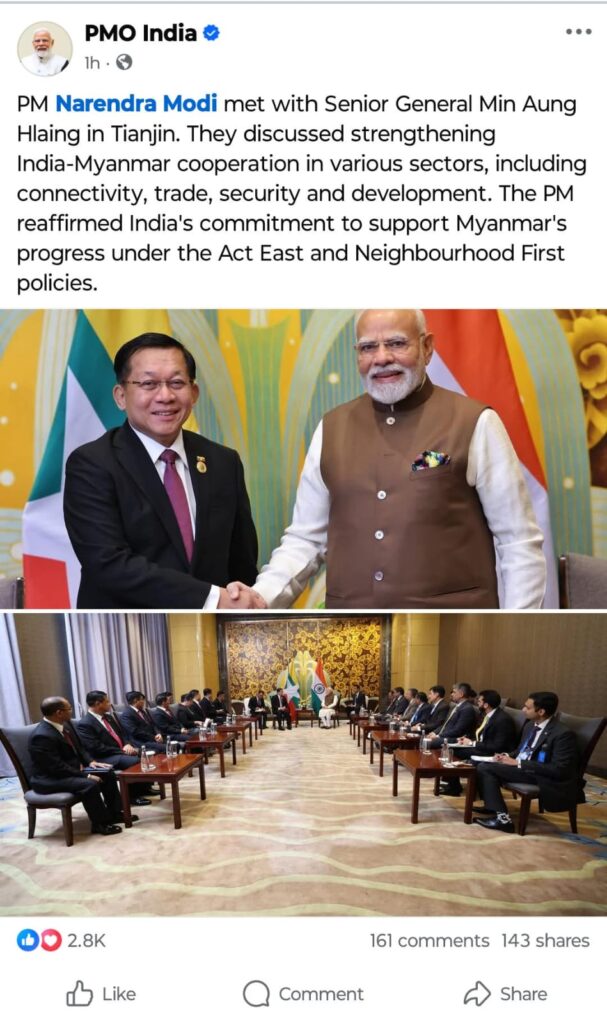
India and Myanmar’s relationship is not just that of neighbouring countries, but is also deeply linked to geographical and strategic needs. For India, Myanmar is the gateway to Southeast Asia and is also an important link for peace in Northeast India. Prime Minister Modi once again emphasized that Myanmar’s stability has a direct impact on the peace of states like Manipur and Mizoram. This is not just a diplomatic statement, but also a practical concern of New Delhi.
The two leaders discussed several issues in the meeting. First of all, there was a discussion on connectivity. Both sides agreed that it is necessary to take the Kaladan Multi-Modal Transit Transport Project forward. The project connects Kolkata to Sittwe Port in Myanmar and from there to Mizoram. On paper, the project could be a game-changer for trade and the local economy, but it has been hampered so far by security concerns and delays. Modi expressed his desire to overcome this impasse.
On trade and development, the two countries agreed to “enhance bilateral trade” and keep the movement of goods across the border smooth. India also assured that it will continue to support small-scale development work in Myanmar. These projects may not make headlines, but are extremely important for the rural areas.
The two leaders also shared views on the security front. Given the long and sensitive border, it was acknowledged that there is no room for complacency. Challenges such as militant groups, cross-border arms smuggling and human trafficking still remain serious. Both sides stressed the need for greater coordination in this area.
The most sensitive issue was the discussion on political and democratic aspects. Modi expressed hope that the upcoming elections in Myanmar will be “fair and inclusive”. This statement was a cautious attempt to push the military government towards a democratic process. India has consistently supported the “Myanmar-led, Myanmar-owned” peace process so that it does not appear to be an interference and Myanmar’s sovereignty is maintained.
Analysts believe that this meeting clarifies India’s diplomatic strategy. New Delhi does not want to let Myanmar’s military government go completely into China’s camp by distancing itself from it. At the same time, India also does not want to be seen as a supporter of a regime that suppresses democracy and civil rights. This is an attempt to strike a balance—maintaining the security of the border and projects and at the same time giving a message of democratic values.
The importance of this meeting is clear. India’s aim is to limit China’s influence, especially on ports and energy corridors. Also, by strengthening border security, reduce insurgency activities in the Northeast and move forward long-stalled infrastructure projects.
Ultimately, while official statements paint a positive picture, the real message is that India wants to play its role as a reliable partner for Myanmar—even if that means accommodating the controversial regime. Whether this strategy will bring stability or simply maintain the status quo is still uncertain.


